
HackademIA Spring Semester 2026
Here are the challenges!
Data For Change + AICrowd Challenges Geneva-based NGO Data for Change and local AI startup AICrowd are developing an AI tool for automating crowdsourced phone surveys to gather data for National Statistics Offices (NSOs) in the Global South. Participants in these six challenges will learn to develop and test the phone survey software as well as analyze historical survey data sets from NSOs.
- Use-Case Fit: Where Does AI Voice Data Add Real Value?
Identify the most realistic and impactful use cases for AI-powered conversational surveys in public-interest contexts. Focus on where this approach is clearly better than traditional data collection methods.
- Trust & Response: Designing for Participation and Uptake
Explore how survey design (voice, scripts, consent flows) influences trust, response rates, and data quality. What makes people comfortable enough to engage and share honestly?
- Bias & Data Quality: Ensuring Inclusive and Representative Data
Assess risks of exclusion (e.g., language, access, gender, disability) and bias in AI-driven surveys. Propose ways to measure, mitigate, and transparently report these risks.
- Governance & Privacy: Making the Approach Legitimate and Safe
Examine the legal, ethical, and institutional requirements for deploying AI voice surveys. What safeguards are needed to ensure privacy, consent, and responsible data use?
- Operational Value: Proving Impact and Scalability
Define what success looks like in real-world deployment. What metrics, benchmarks, and cost-benefit indicators would justify adoption by governments or organizations?
- Clustering Insights for Policy Decisions (with International Labour Organization)
Use unsupervised learning (e.g., clustering) to extract meaningful patterns from survey or labor-related datasets. Translate these patterns into actionable policy insights.
TPG Challenges Geneva’s Public Transport Innovation Team is exploring ways to use AI and Crowdsourcing to improve it’s pioneering TPG Flex on-demand service, currently operating in rural areas of the Canton, in order to adapt the service for wider use in the Geneva area.
- Smart Vehicle Dispatch: Where Should Vehicles Be Positioned?
Determine optimal stop and wait locations (areas and specific parking spots) for the tpgFlex vehicles to reduce the vehicle empty travel time, minimize wait times, and meet demand efficiently. Consider time-of-day patterns, driver needs, and future automation.
- Fleet Sizing: How Many Vehicles Are Needed, Where and When?
Use operational data to forecast the minimum/maximum number of vehicles required per geographic area and time period based on the number of bookings/passengers. Develop tools such as heatmaps to visualize demand and supply gaps.
- Dynamic Reallocation: Managing Disruptions in Real Time
Design strategies to reassign bookings when a vehicle becomes unavailable. Explore trade-offs between efficiency and passenger experience, including rerouting occupied vehicles.
- Accessible Mobility App: Designing for All Users
Create or improve a mobile/web crowdsourcing application that is inclusive for people with disabilities and low digital literacy. Focus on usability, accessibility standards, and intuitive design.
- AI Customer Service Agent (Voice-Based Booking Support)
Develop an AI-powered phone assistant to help users book, modify, or cancel trips—especially those who cannot use apps or digital tools. Ensure clarity, reliability, and accessibility.
- AI-Powered Survey System for Transport Users
Design an intelligent system to collect passenger feedback via phone, online, or in-vehicle surveys. Explore how AI can improve response rates, insights, and user experience.
Join us for hackademIA
What happens when you combine the scale of the “crowd” with the precision of Artificial Intelligence?
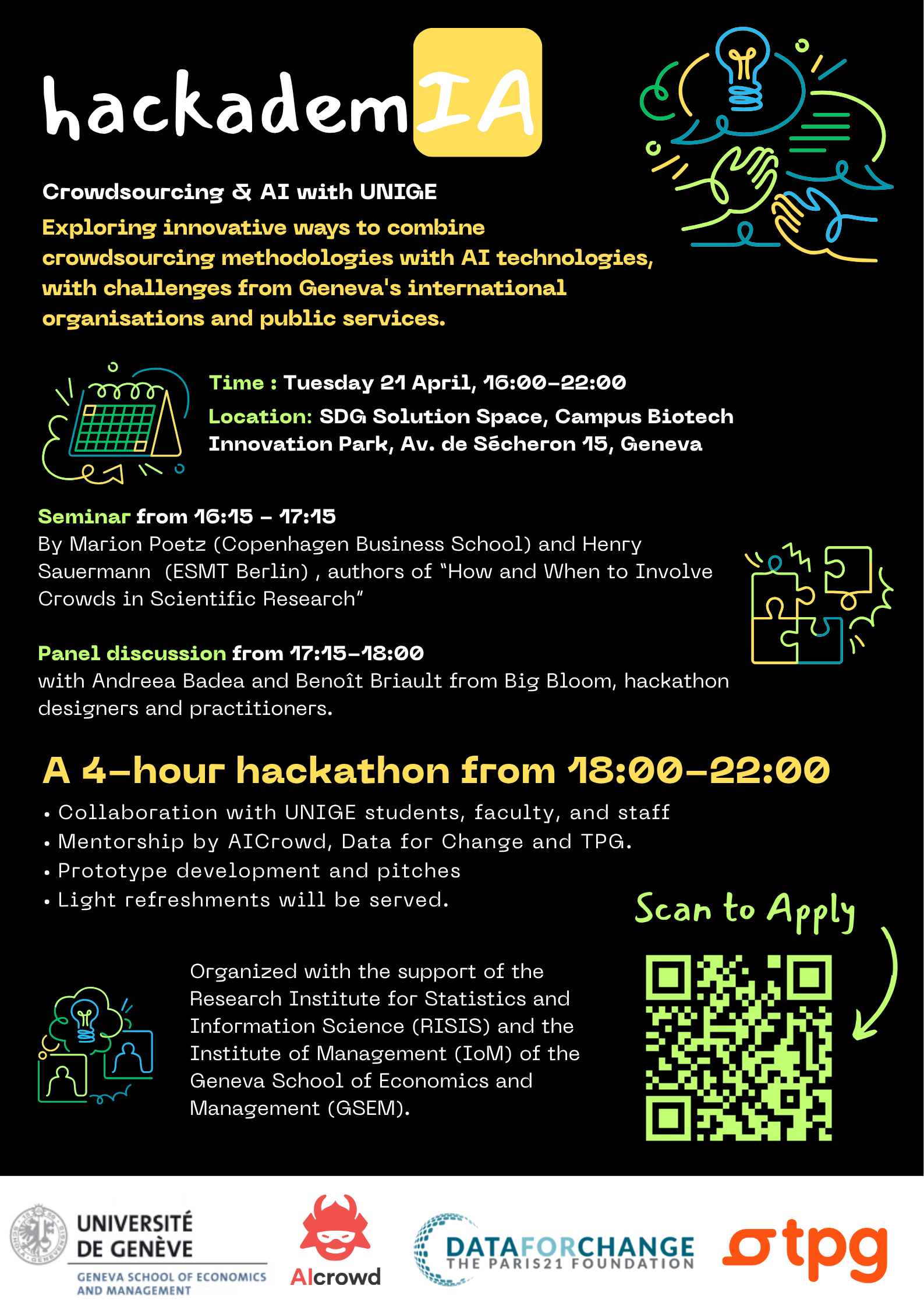
On Tuesday, 21 April 2026, the SDG Solution Space will host the second edition of hackademIA: a high-energy, four-hour hackathon designed to explore the frontier of crowdsourcing and AI. Whether you are a student, a researcher or a professional in the Geneva innovation ecosystem, this is your chance to see how these two forces are reshaping how we solve both local and global challenges.
Why Crowdsourcing and AI?
We live in an era of “big data,” but data alone doesn’t solve problems—insight does. Crowdsourcing allows us to tap into diverse human perspectives at scale, while AI provides the tools to process, accelerate, and refine those contributions. Together, they create a “collective intelligence” that is essential for sustainable development and scientific breakthroughs.
The Lineup: From Theory to Practice
We are thrilled to kick off the afternoon with a deep dive into the mechanics of these methodologies:
-
Expert Keynote: Join Marion Poetz and Henry Sauermann, authors of “How and When to Involve Crowds in Scientific Research,” as they share the latest frameworks for integrating public participation into high-level science.
-
Industry Insights: Following the keynote, we’ll host a panel discussion with Andreea Badea and Benoît Briault from Big Bloom, seasoned hackathon designers and practitioners.
Walking the Talk
This isn’t just a seminar. The heart of the afternoon/evening is a fast-paced hackathon where UNIGE students, faculty, and staff will work alongside mentors from International Organizations, NGOs, public services and local tech companies.
Key Highlights:
-
Hands-on AI Challenges: Tackle real-world challenges with mentors from the challenge-givers.
-
Collaboration: Work alongside UNIGE students, faculty, and staff to tackle complex issues together.
-
Mentorship: Collaborate with local NGOs and leading tech companies with hands-on expertise.
-
Prototype & Pitch: Develop a working prototype and present your vision to mentors and peers.
Event Details
-
When: Tuesday, 21 April 2026 | 16:00 – 18:00
-
Where: SDG Solution Space, Campus Biotech Innovation Park, Av. de Sécheron 15, Geneva
-
Cost: Free entry (Registration required)