HackademIA
Shaping the Future of Research: Join us for hackademIA
What happens when you combine the scale of the “crowd” with the precision of Artificial Intelligence?
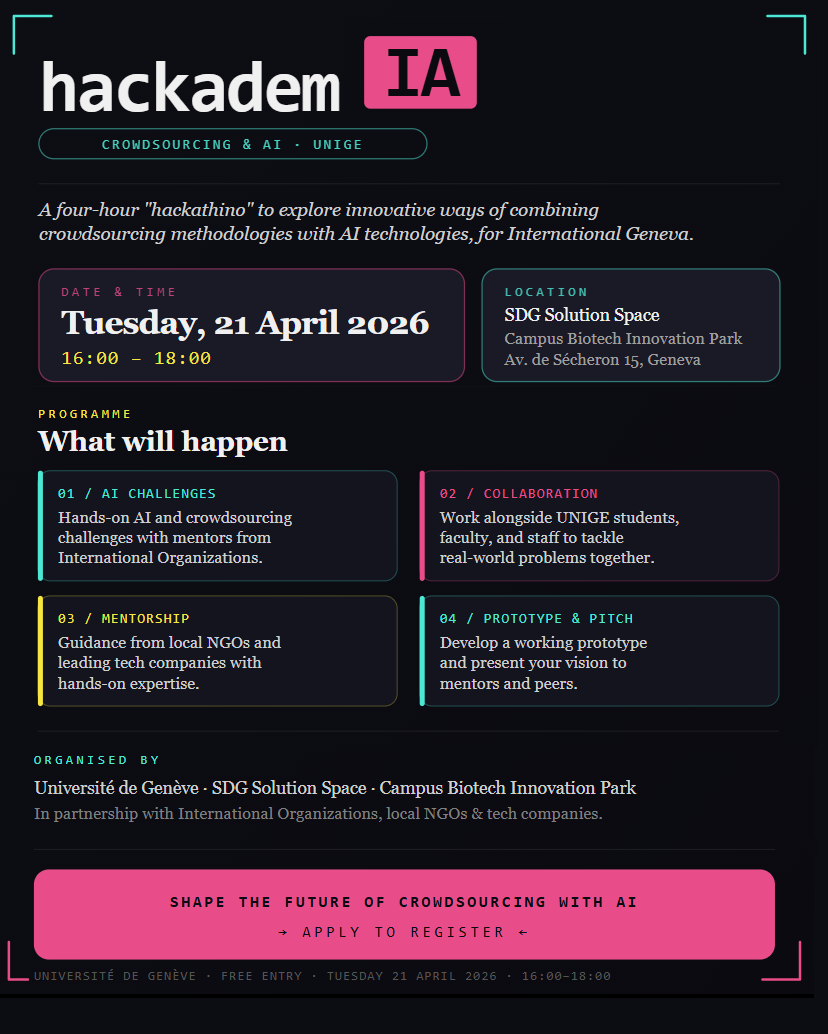
On Tuesday, 21 April 2026, the SDG Solution Space will host hackademIA: a high-energy, four-hour “hackathino” designed to explore the frontier of crowdsourcing and AI. Whether you are a student, a researcher, or a professional in the International Geneva ecosystem, this is your chance to see how these two forces are reshaping how we solve global challenges.
Why Crowdsourcing and AI?
We live in an era of “big data,” but data alone doesn’t solve problems—insight does. Crowdsourcing allows us to tap into diverse human perspectives at scale, while AI provides the tools to process, accelerate, and refine those contributions. Together, they create a “hybrid intelligence” that is essential for sustainable development and scientific breakthroughs.
The Lineup: From Theory to Practice
We are thrilled to kick off the afternoon with a deep dive into the mechanics of these methodologies:
-
Expert Keynote: Join Marion Poetz and Henry Sauermann, authors of “How and When to Involve Crowds in Scientific Research,” as they share the latest frameworks for integrating public participation into high-level science.
-
Industry Insights: Following the keynote, we’ll host a panel discussion with Andreea Badea and Benoît Briault from Big Bloom, seasoned hackathon designers and practitioners.
What Will Happen?
This isn’t just a “sit and listen” event. The heart of the afternoon is a fast-paced workshop where UNIGE students, faculty, and staff will work alongside mentors from International Organizations, NGOs, and tech companies.
Key Highlights:
-
Hands-on AI Challenges: Tackle real-world crowdsourcing problems with mentors from International Organizations.
-
Collaboration: Work alongside UNIGE students, faculty, and staff to tackle complex issues together.
-
Mentorship: Receive guidance from local NGOs and leading tech companies with hands-on expertise.
-
Prototype & Pitch: Develop a working prototype and present your vision to mentors and peers.
Event Details
-
When: Tuesday, 21 April 2026 | 16:00 – 18:00
-
Where: SDG Solution Space, Campus Biotech Innovation Park, Av. de Sécheron 15, Geneva
-
Cost: Free entry (Registration required)
Shape the future of crowdsourcing with AI!